
Money and Time Activities for Kindergarten
Money Poems and Songs
ABC Money Rap
Written by Ali from Kinderkorner
A B C D E
Learning coins is fun for me.
F G H I J
A penny is one cent, hooray!
K L M N O
Five cents make a nickel, you know.
P Q R S T
A dime is worth ten cents, you see.
U V W X Y
Twenty-five cents is a quarter, oh my!
Z Z Z Z Z
Kinders know about money!
Coin Poems
Penny
Penny, Penny, easily spent,
Coppery brown and worth 1 cent.
Nickel
Nickel, Nickel, thick and fat,
You’re worth 5 cents, I know that!
Dime
Dime, Dime, little and thin,
I remember, you’re worth 10.
Quarter
Quarter, Quarter, big and bold,
You’re worth 25 cents, I’m told.
Half Dollar
Half-a-dollar, Half-a-dollar, giant size,
50 cents to buy some fries.
Dollar
Dollar, Dollar, green and long,
Worth 100 cents, you can’t go wrong!
Money Rap
Well, I know a song.
It’s really kind of funny.
It’s all about coins
And learning to count money.
Pennies, nickels, dimes, and quarters!
Pennies, nickels, dimes, and quarters!
Now a penny means one.
(Hold out one finger.)
And a nickel means five.
(Hold out five fingers.)
Dimes are worth ten.
(Hold out ten fingers.)
And quarters twenty-five.
(Show ten fingers twice, then five.)
Pennies, nickels, dimes, and quarters!
Pennies, nickels, dimes, and quarters!
Five pennies in a nickel.
(Hold out one hand with fingers stretched.)
Two nickels in a dime.
(Hold out two fingers.)
Five nickels in a quarter.
(Hold out one hand with fingers stretched.)
You’ll know it every time!
(Using both hands, make a downward motion.)
Pennies, nickels, dimes, and quarters!
Pennies, nickels, dimes, and quarters! Yeah!
Dr. Jean’s Money Song
Tune: “Shortnin’ Bread”
Chorus:
I like money to buy things at the store.
Money, money, money, I always want more!
A penny’s worth one cent.
A nickel’s worth five.
A dime’s worth ten cents.
A quarter’s twenty-five.
(Repeat chorus.)
Lincoln’s on one cent.
Jefferson’s on five.
Roosevelt’s on ten cents.
Washington’s on twenty-five.
(Repeat chorus.)
A building’s on one cent.
A building’s on five.
A torch is on ten cents.
An eagle’s on twenty-five.
(Repeat chorus.)
Bubble Gum Song
Chorus:
Oompa, oompa, bubble gum!
Oompa, oompa, bubble gum!
Verse 1: Penny
My mommy gave me a penny.
She told me to buy a jenny. (A mule.)
But I didn’t buy a jenny.
Instead, I bought bubble gum.
(Repeat chorus.)
Additional Verses:
- Nickel — Pickle
- Dime — Lime
- Quarter — Porter (Porterhouse steak)
- Dollar — Collar
Money Song
Tune: “Itsy Bitsy Spider”
1 cent is a penny,
10 cents is a dime,
5 cents is a nickel,
Now you know that I’m…
Learning about the money,
And which coin is which.
Don’t forget the quarter—
It’s worth 25 cents!
Three Shiny Quarters
Three shiny quarters
In a pocketbook new.
(Hold up three fingers.)
One bought a gumball,
Then there were two.
(Bend down one finger.)
Two shiny quarters,
Before the day was done,
One bought a sticker,
Then there was one.
(Bend down another finger.)
One little quarter,
I heard it plainly say,
“I’m going in the piggy bank
For a rainy day!”
Found a Penny
Tune: “Found a Peanut”
Found a penny,
Found a penny,
Found a penny just now.
Just now I found a penny.
Found a penny just now.
It’s worth 1 cent.
It’s worth 1 cent.
It’s worth 1 cent just now.
Just now, it’s worth 1 cent.
It’s worth 1 cent just now.
Money Activities and Learning Centers
Magic Money: Cleaning Pennies
Source: Parents Magazine, March 1995
Materials:
- Pennies
- Small bowl
- Salt
- White vinegar in a small squeeze bottle
- Cotton swabs
- Paper napkin
- Tray
- Piggy bank or small container
Instructions:
- Arrange the materials on a tray.
- Have the child place a penny into the bowl.
- Sprinkle salt over the penny.
- Add a few drops of white vinegar.
- Watch as the penny begins to shine.
- Use a cotton swab to gently scrub the penny.
- Wipe the penny dry with a napkin.
- Place the cleaned penny into a piggy bank or another container.
This activity allows students to observe how the vinegar and salt mixture removes tarnish from pennies.
Adult supervision is recommended. Wash hands after handling coins, and do not use the cleaned pennies for food-related activities.
Coin Trading Mat
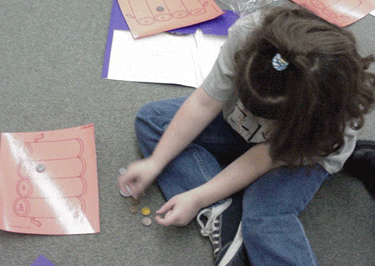
Use a coin mat to teach students how to exchange coins of equal value.
Materials:
- Coin trading mats with columns for different coin values
- Pennies
- Nickels
- Dimes
Instructions:
- Have students place pennies in the one-cent column.
- When they collect five pennies, have them trade those pennies for one nickel.
- Place the nickel in the five-cent column.
- Continue collecting and trading coins.
- Demonstrate how two nickels can be exchanged for one dime.
Money Sorting Center
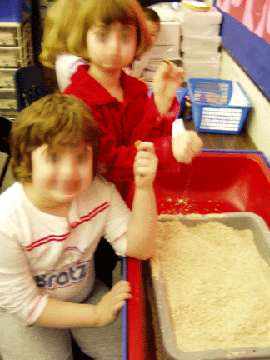
Create a sensory-based money activity by burying coins in a container of oatmeal or another sensory material.
Materials:
- Coins
- Large container
- Oatmeal or other sensory material
- Sorting trays or containers
- Recording sheets
- Coin stamps
Instructions:
- Hide coins throughout the oatmeal.
- Have students search for and collect the coins.
- Students sort the coins by type.
- Count how many of each coin they found.
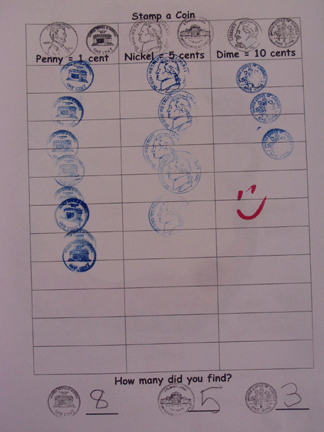
Students can use coin stamps to record the number of each type of coin they discovered.
For young children, use oversized play coins to avoid choking hazards.
Guess the Coin
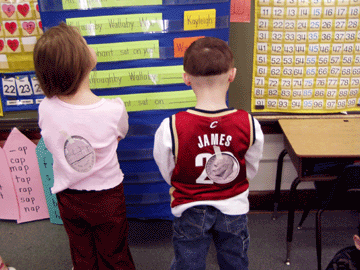
Materials:
- Large paper coin pictures
- Tape
Instructions:
- Tape a large coin picture to a student’s back without showing them which coin it is.
- Have classmates give clues about the coin.
- The student listens to the clues and guesses the coin.
Example Clues:
- It’s worth 5 cents.
- It’s brown.
- It’s a large coin.
- It has Abraham Lincoln on it.
Use clues appropriate for the particular coin.
Classroom Money System
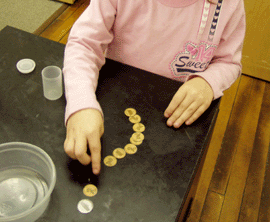
Set up a classroom economy to give students hands-on experience earning, counting, and spending money.
For this activity, I used only pennies and nickels.
Earning Money:
Students received classroom money for activities such as:
- Coming to school: 6 cents
- Bringing books: 2 cents
- Returning papers: 2 cents
Spending Money:
Students used their classroom money to purchase mid-morning snacks costing 4, 5, or 6 cents.
In the original activity, students also paid 2 cents when their behavior card was changed.
At the end of each day, students counted their remaining money and used it to purchase items from the classroom treasure chest.
Teacher’s Note:
This activity is time-consuming, so I recommend using it for only a week or two. However, it really helped students learn to count money.
Trading Coins: Box It or Bag It
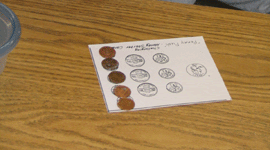
This coin trading worksheet came from Box It or Bag It, but a similar activity could be created using coin stamps.
Have students place five pennies on their papers.
Next, they trade the five pennies for one nickel.
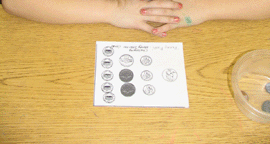
Students collect another five pennies and exchange them for a second nickel.
Finally, they trade their two nickels for one dime.
This activity demonstrates equivalent coin values through hands-on exchanges.
Pocket Change
Materials:
- Paper pocket cutouts
- Tagboard
- Coin stamps
- Small pieces of paper
- Glue
Instructions:
- Glue several paper pockets onto a sheet of tagboard.
- Stamp different combinations of coins onto the pockets.
- Have students count the total value of the coins shown on each pocket.
- Students write the amount on a small piece of paper.
- They place their answers inside the corresponding pockets.
Matching Coins and Prices
Materials:
- Approximately 10 paper hand shapes
- Coin stamps
- Approximately 20 picture cards showing items and prices
Instructions:
- Cut out approximately 10 paper hand shapes.
- Stamp different coin combinations onto each hand.
- Create about 20 picture cards featuring items with prices that match the coin values on the hands.
- Provide two possible matching cards for each hand.
- Have students count the coins and match them to the correct prices.
Time Activities
The Human Clock
Shared by Mary in Brooklyn
Featured Book: The Grouchy Ladybug by Eric Carle
Materials:
- The Grouchy Ladybug by Eric Carle
- 12 large number cards (8½ × 11 inches), numbered 1–12
- Blue satin ribbon for the hour hand
- Red satin ribbon for the minute hand
- Small index cards with specific times written on them
- Paper bag or hat to hold the time cards
- Cardboard practice clocks (optional)
Instructions:
- Read The Grouchy Ladybug aloud to the class and discuss the story, focusing on the times shown throughout the book.
- Select 12 students to represent the hours on a clock.
- Give each student a large number card and have them stand in a circle in the correct clock positions.
- Select two students to represent the hour hand. One child stands in the center of the circle holding one end of the blue ribbon, while the other stands near the clock numbers holding the opposite end.
- Repeat with two additional students and the red ribbon to represent the minute hand.
- Choose student callers to draw time cards from the bag and announce the times.
- The students holding the ribbons move to represent the correct hour and minute positions on the clock.
- Continue with different times, allowing students to rotate through the roles.
Teaching Tips:
Depending on class size, students can take turns being the clock numbers, clock hands, or callers.
For larger groups, give students individual cardboard clocks so they can follow along and practice showing the same time as the Human Clock.
This is always a fun, interactive lesson!