Shapes Teaching Theme: Poems, Songs, Books, and Activities
Shape Poems
Source unknown
Cindy Circle
I am Cindy Circle.
Watch me turn
Round and round and you will learn
I’m not straight and I don’t bend.
My outside edges never end.
Sammy Square
Sammy Square is my name.
My four sides are just the same.
Turn me around, I don’t care.
I’m always the same. I’m a square!
Tommy Triangle
Tommy Triangle is the name for me.
Count my sides—there’s one, two, three.
Ricky Rectangle
Ricky Rectangle is my name.
My four sides are not the same.
Two are short and two are long.
Count my sides. Come along—one, two, three, four.
Danny Diamond
I am Danny Diamond.
I am like a kite.
But I’m really just a square
Whose corners are pulled tight.
Opal Oval
Opal Oval is my name.
The circle and I are not the same.
The circle is round, as round as can be.
I am shaped like an egg, as you can see.
Harry Heart
Harry Heart is my name.
The shape I make is my fame.
With a point on the bottom and two humps on top,
When it comes to love I just can’t stop.
Shelby Star
Shelby Star is my name.
Shining brightly is my game.
With five sparkly points and lots of sides, too.
With wishes I make dreams come true.
Shape Books
- So Many Circles, So Many Squares by Tana Hoban
- Circles, Triangles and Squares by Tana Hoban
- Shapes, Shapes, Shapes by Tana Hoban
- Dots, Spots, and Squares by Tana Hoban
- Round and Round and Round by Tana Hoban
- Circles and Squares Everywhere by Max Grover
- Brown Rabbit’s Shape Book by Baker
- What Is Square? by Dotlich
- Shapes in Nature by Feldman
- Shapes, Shapes, All Over the Place by Gill
- A Fishy Shape Book by Wylie
Shape Songs and Chants
Circle Song
Tune: “If You’re Happy and You Know It”
A circle is a shape that goes round.
A circle is a shape that goes round.
A circle is a shape that goes round,
And round and round.
A circle is a shape that goes round.
Shape Chant
One square, two squares,
This is what we call a pair.
Three rectangles on the floor,
Four triangles, count some more.
Five circles all around.
Here’s a star that I have found!
Hexagon I can hop,
Octagon means STOP!
Oval,
Diamond,
And a heart.
Now let’s go back to the start!
Triangle Tricks
By Heather Tekavec
Materials: Five identical paper triangles and a flannelboard.
Cut five identical triangles and manipulate them on a flannelboard as you read the poem.
One little triangle, sitting very still,
A tiny ant marching by might think that it’s a hill.
Two small triangles make a pretty sight,
Joined together in the sky, they look just like a kite.
Three small triangles, stack them one, two, three,
In the forest you would think that they were one big tree.
Four small triangles, pointing all together,
Make a pinwheel that can spin in windy kind of weather.
Five small triangles, the fanciest by far,
When they all join round and round, they make a flashy star.
ABCDE Shape Chant
Place this chant in a pocket chart with a picture of the corresponding shape on each line.
A B C D E
Draw a circle now with me.
(Skywrite a circle.)
F G H I J
Can you draw a square this way?
(Skywrite a square.)
K L M N O
A triangle has 3 points, you know.
(Skywrite a triangle.)
P Q R S T
A rectangle looks like this, you see.
(Skywrite a rectangle.)
U V W X Y Z
Drawing shapes is fun for me!
It’s a Rectangle
Tune: “B-I-N-G-O”
There is a shape that has four sides,
But it is not a square… No!
It’s a rectangle;
It’s a rectangle;
It’s a rectangle;
It is not like a square… No!
Two sides are long; two sides are short.
They are not the same… No!
It’s a rectangle;
It’s a rectangle;
It’s a rectangle;
The sides are not the same… No!
This Is a Square
Tune: “Frère Jacques”
This is a square. This is a square.
How can you tell? How can you tell?
It has four sides,
All the same size.
It’s a square. It’s a square.
Square Song
Tune: “The Farmer in the Dell”
A square is like a box,
A square is like a box,
It has four sides,
They are the same.
A square is like a box!
Triangle Song
Tune: “The Farmer in the Dell”
A triangle has 3 sides,
A triangle has 3 sides,
Up the mountain,
Down, and back.
A triangle has 3 sides!
Circle Song
Tune: “The Farmer in the Dell”
A circle’s like a ball,
A circle’s like a ball,
Round and round
It never stops.
A circle’s like a ball!
Rectangle Song
Tune: “The Farmer in the Dell”
A rectangle has 4 sides,
A rectangle has 4 sides,
Two are long, and
Two are short.
A rectangle has 4 sides!
Other Shape Ideas and Activities
Making Shapes with Yarn
Materials: 18-inch lengths of yarn
Tie an 18-inch length of yarn into a loop.
Have students lay the yarn on the floor and manipulate it to create different shapes:
- Circle
- Square
- Triangle
- Rectangle
- Oval
- Diamond
Shape Scavenger Hunt
Take students on a shape scavenger hunt around the classroom, throughout the school, or outdoors.
Use a digital camera to photograph objects representing different shapes.
Combine the photographs into a class shape book. Add a sentence to each page identifying the object and its shape.
Example: “The window is a rectangle.”
Shape Party
Invite parents to donate foods representing different geometric shapes. Students can identify and sort the foods by shape before enjoying their snacks.
Suggested Foods:
- Circles: M&Ms, Oreos, Nilla wafers
- Squares: Cheese Nips, Saltines, Wheat Thins
- Rectangles: Graham crackers, sugar wafers, ice cream sandwiches
- Triangles: Doritos, tortilla chips
- Ovals: Ritz crackers
- Spheres: Cheese balls
- Cubes: Caramels or cheese cubes
- Cylinders: Marshmallows
- Cones: Bugles or ice cream cones
Pocket for Snipped Squares
Have students cut small squares from a sheet of paper.
Create a storage pocket by cutting off the bottom portion of the paper and gluing or stapling the sides and bottom.
Students can store their cutout squares in the pocket and take them home for additional practice with their families.
Pattern Block Pictures
Provide students with geometric pattern blocks and encourage them to arrange the shapes to create pictures and designs.
Making Triangles
Use pretzel sticks, toothpicks, or drinking straws to form triangles.
Students can experiment with different sizes and arrangements.
Shape Book: Making Shapes with Our Bodies
Have small groups of students work together to form geometric shapes with their bodies while lying on the floor.
Take photographs of each group and combine the pictures into a classroom shape book.
Shape Monster Book
Create a class book in which a hungry shape monster eats a different shape on each page.
Text for Each Page:
Shape Monster, Shape Monster,
Munch, munch, munch.
How about a __________
For your lunch?
Instructions:
- Create a book cover featuring a monster with its mouth open.
- Make a page for each shape you are studying.
- Include a picture of the monster with its mouth open on every page.
- Have students trace geometric blocks to create the shapes.
- Students color their shapes and glue them into the monster’s mouth on the appropriate pages.
Introducing Tangrams
Adapted from Libby on Kinderkorner
This sequence introduces young children to tangrams by gradually dividing a square into smaller geometric shapes.
Rather than beginning with a complete set of tangram pieces, students discover how the shapes fit together through folding, cutting, and rebuilding activities.
Day 1: Introducing the Square
Suggested timing: Around the second week of school
Begin with an 8-inch paper square.
Introduce the word square and place it on the math word wall with a corresponding picture or icon.
Discuss the characteristics of a square, including its four sides and four corners.
Day 2: Diagonal Folds and Triangles
Teach students how to make a diagonal fold across their squares.
Practice identifying and locating the diagonal.
Introduce the triangle and discuss its characteristics.
Demonstrate how two triangles can fit together to form a square.
Teach students a working definition of a square:
A square is a four-sided polygon with two pairs of parallel sides and four right angles.
Day 3: Exploring Triangles
Prepare the students’ squares by cutting them along the diagonal folds.
Because this activity takes place early in the school year, the teacher can make the cuts in advance so students can concentrate on the geometry rather than their cutting skills.
Have students:
- Identify the longest side of each triangle.
- Reassemble the two triangles to form the original square.
- Rearrange the triangles to make a larger triangle.
- Arrange the triangles to create a trapezoid.
Introduce trapezoid and add it to the math word wall.
Teach students a working definition of a triangle:
A triangle is a three-sided polygon.
Day 4: Making More Shapes
Have students fold one of their triangles to create two smaller triangles.
Practice rebuilding the original triangle.
Challenge students to use their pieces to create a square and a larger square.
Day 5: Introducing the Rhombus
Before the lesson, fold the tip of the largest triangle to create a smaller triangle and a remaining rhombus shape.
Show students the new fold and help them identify the triangle and rhombus.
Introduce rhombus and add it to the math word wall.
Have students practice putting the pieces back together.
Days 6–10: Building the Tangram
Continue cutting one piece each day and practicing reassembling the pieces into their original shapes.
Introduce the size words small, medium, and large on the math word wall.
Gradually taking apart the tangram helps students understand the properties of geometric shapes and develop spatial awareness.
Once all the pieces have been separated, replace the paper tangrams with plastic tangram sets.
Exploring Tangrams
Provide opportunities for students to experiment with their tangram pieces.
Suggested Challenges:
- How many different ways can you make a triangle?
- How many ways can you make a square?
- Can you make a rectangle?
- Can you make a square using one piece? Two pieces? Three pieces?
- Can you build a shape using four, five, six, or seven pieces?
Encourage students to explore different combinations and explain how they arranged their shapes.
Tangrams and Literature
After students have spent time exploring and manipulating their tangrams, introduce the book Grandfather Tang’s Story.
By approximately the third week, students should have enough experience with the shapes to appreciate how the tangram pieces are used to create the illustrations.
Tangram Literacy Center:
Make a second copy of the book and separate its pages for use in a classroom center.
Students can use their tangram pieces to recreate the illustrations as they explore the story.
Tangram Challenge Cards
Create a deck of tangram challenge cards.
Put a tangram design on one side of each card and its solution on the back.
Display a new challenge every day or two.
Place the challenge card in a sheet protector and display it on a small tabletop easel so students can refer to it as they work.
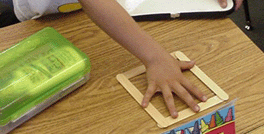
A Perfect Child in a Perfect Square
Make a square picture frame by gluing four popsicle sticks together and painting. Have each child draw his picture in
the square box. Hole punch in the triangle part and hang from string attached to one side of a popsicle stick frame.
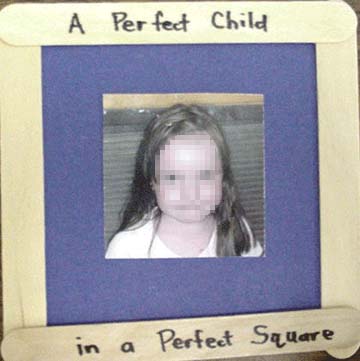
(OK-so maybe it’s not a perfect square!)
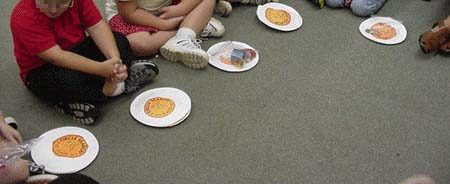
“Family Homework” was a circle search. Two paper plates are stapled together halfway up, creating a circle envelope. Students put circular objects inside and brought them to school to share.
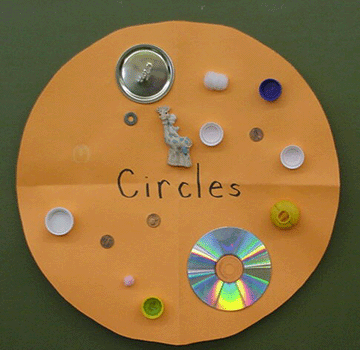
Cut a large circle shape and glue on one circular item from the Circle Search homework described above.
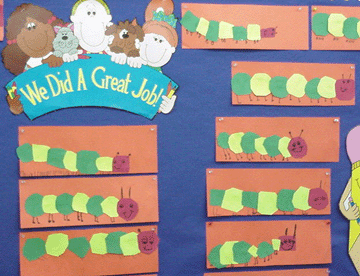
The traffic light and the caterpillar art projects help students learn to cut a circle shape. Both are from the Beginnings book, published by TLC Art. (http://www.tlcart.com)
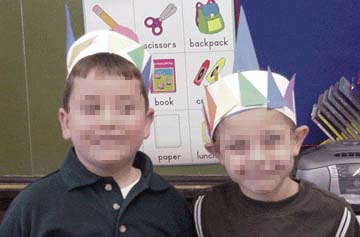
Students glued triangles to headbands to make hats. This is a good activity to accompany reading, “Where the Wild Things Are”.
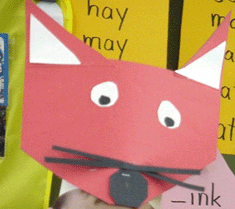
This fox head was made by trimming off the corners of a square for the triangle ears. Then it was attached to a headband.
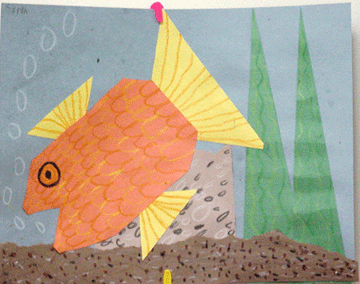
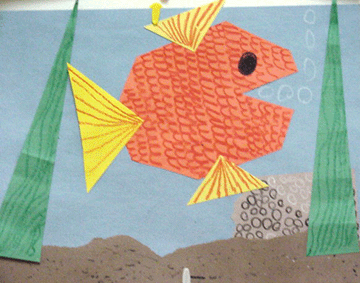
This fishy project was created by cutting the corners off of a rectangle to make the fish. Then triangles were added for the fins and sea plants. Thanks to our art teacher, Ms. Bittle, for these projects.
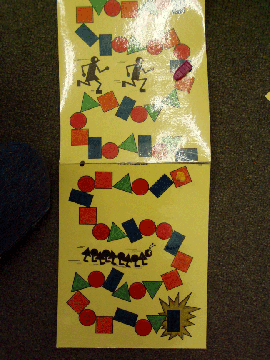
This “Shape Race” game uses the pattern cards on the right for the players to move toward the finish box. This is an old game by Box It or Bag It Math.
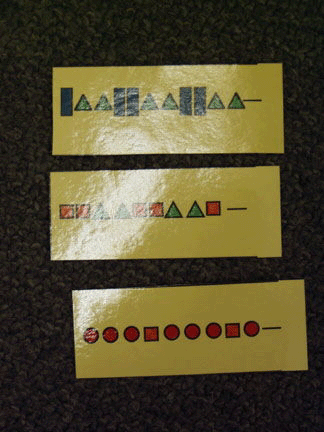
These pattern cards are placed face down. Players take turns drawing a card and telling what comes next in the pattern. Then they move their marker on the Shape Race game to the next place that shape appears on the gameboard.
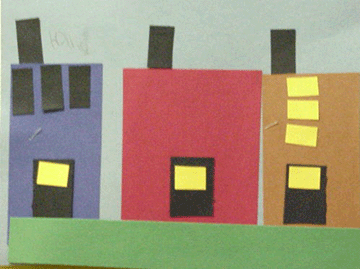
Glue different size rectangles on paper to make a picture–another idea from Ms. Bittle.
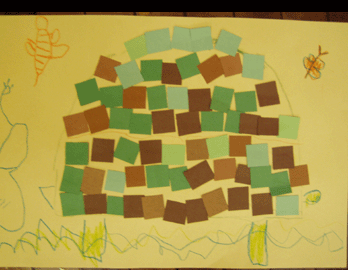
This turtle was drawn and the shell was filled in with pre-cut colored squares.
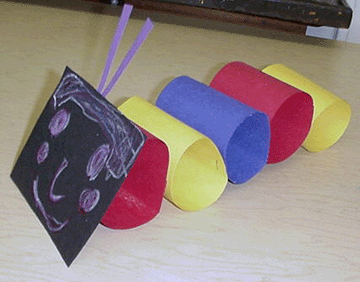
These cylinders were glued together to form a caterpillar and a square head was attached.
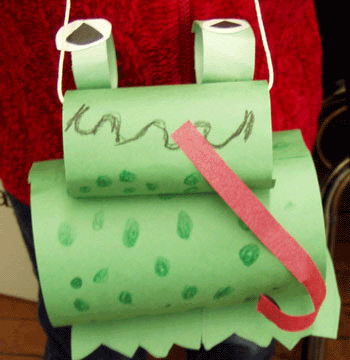
This is a frog made from cylinders.
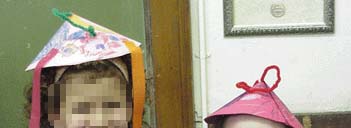
Watch out for the coneheads! A circle was slit to the center and then overlapped to form a cone shape. A pipe cleaner and crepe paper streamers complete
the “look”!
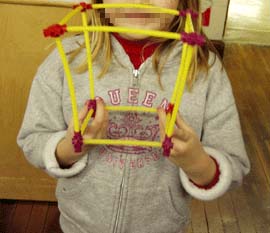
Use toys to create 3-D shapes. Cubes and rectangular prisms can also be made using toothpicks and miniature marshmallows.
Thanks to our wonderful art teacher, Ms. Bittle, for using literature and art to reinforce the plane and solid shapes our kindergarten students learn!