Apples, Johnny Appleseed Teaching Theme
Apple Poems and Songs
Five Red Apples
Counting rhyme — Author unknown
Five red apples hanging in a tree,
The juiciest apples you ever did see.
The wind came by and gave an angry frown,
And one little apple came tumbling down.
Four red apples… (Continue counting down to one.)
Grandpa’s Farm
Jump rope rhyme — Author unknown
I went down to Grandpa’s farm,
Billy goat chased me round the barn.
Chased me up the apple tree,
Butted the tree to get at me.
How many apples round and red,
Fell on that old billy goat’s head?
1, 2, 3, etc.
Apples
Apples,
Apples,
Apples.
We love apples.
Big apples,
Little apples,
Medium-sized apples.
We love apples.
Sweet apples,
Sour apples,
Just-right apples.
We love apples.
Crunchy apples,
Mushy apples,
Juicy apples.
We love apples.
But not rotten apples—
We HATE them!
Do You Know the Apple Man?
Tune: “The Muffin Man”
Oh, do you know the Apple Man,
The Apple Man, the Apple Man?
Oh, do you know the Apple Man?
He planted apple seeds.
He wore a pot upon his head,
Upon his head, upon his head.
He wore a pot upon his head.
His name was Johnny Appleseed.
John Chapman was his real name,
His real name, his real name.
John Chapman was his real name;
But we call him Johnny Appleseed.
Apple Books and Literature
- An Apple a Day
- The Seasons of Arnold’s Apple Tree by Gail Gibbons
- The Apple Pie Tree
- I Am an Apple by Jean Marzollo
- Johnny Appleseed by Steven Kellogg
- Johnny Appleseed by Madeline Olsen
- Apples, Apples, Apples by Nancy Elizabeth Wallace
- Apples and Pumpkins by Anne Rockwell
- Big Red Apple by Tony Johnston
- Apple Fractions by Jerry Pallotta
Literacy Activities
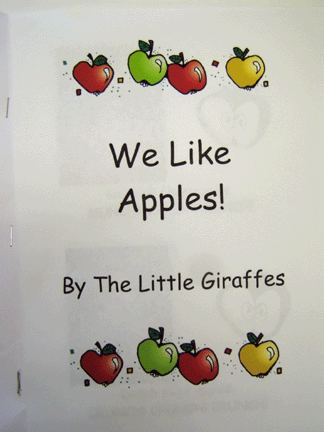
Crunchy Munchy Class Book
Idea shared by Kerry on the Kinderkorner webring.
Create an interactive class book using a simple apple poem.
Original Poem:
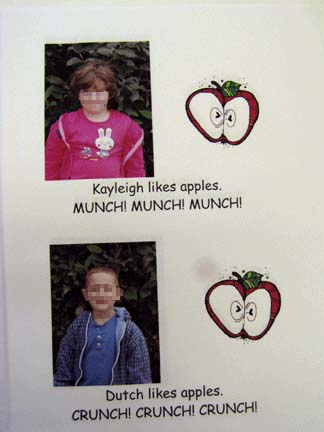
I like apples.
MUNCH! MUNCH! MUNCH!
I like apples.
CRUNCH! CRUNCH! CRUNCH!
Class Book Version:
____________ likes apples.
MUNCH! MUNCH! MUNCH!
____________ likes apples.
CRUNCH! CRUNCH! CRUNCH!
Example:
Sarah likes apples.
MUNCH! MUNCH! MUNCH!
Robert likes apples.
CRUNCH! CRUNCH! CRUNCH!
Create pages featuring students’ names and pictures. Read the finished book together, encouraging children to recognize their classmates’ names and join in on the repeated words.
We Have Apples Up on Top Class Book
Book: Ten Apples Up on Top!
After reading Ten Apples Up on Top!, create a class book featuring each student.
Sentence Pattern:
____________ has ____________ apples up on top.
Instructions:
- Take a photograph of each student.
- Have students choose a paper apple with a number written on it.
- Students glue the corresponding number of apples above their pictures. Red circle stickers can also be used.
- Add the completed sentence to each page.
- Combine the pages into a class book.
An alternative is to use portions of the apple poem beneath each child’s photograph.
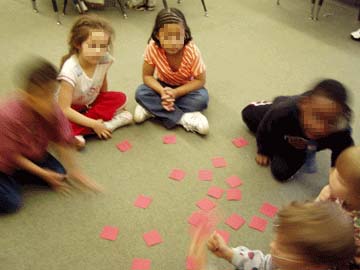
Rotten Apple Game
Materials:
- Paper apple cutouts
- Markers
- Words, letters, or numbers for review
Instructions:
- Write letters, words, or numbers that students need to practice on paper apple cutouts.
- Draw a worm on one or two apples to represent rotten apples.
- Place the apples face down.
- Students take turns choosing an apple.
- If a student correctly reads or identifies what is written on the apple, they keep it.
- If a student chooses a rotten apple, they must return all of their collected apples.
Continue playing until the activity is finished.
Predictable Apple Chart
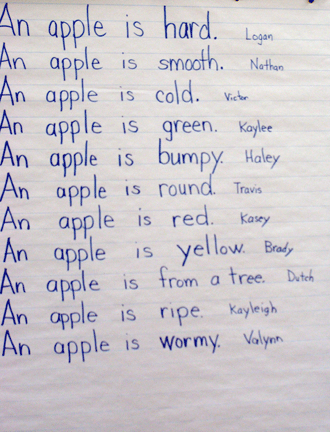
Provide green, yellow, and red apples in different sizes for students to observe and touch.
Ask each child to contribute a word describing the apples.
Record their descriptive words on a predictable classroom chart.
Reread the chart together over several days to reinforce vocabulary, print awareness, and reading fluency.
Apple Bingo
Materials:
- Large paper apple shapes
- Markers
- Seeds or other bingo markers
Instructions:
- Draw a grid of squares on each apple shape.
- Fill the squares with letters, numbers, or words students are learning.
- Draw seeds in the center free space.
- Have students play bingo, covering the appropriate squares as items are called.
The Story of the Little Red House
There was once upon a time a little boy named John who was tired of all his toys and tired of all his picture books and tired of all his play.
“What shall I do?” he asked his mother.
His dear mother, who always knew beautiful things for little boys to do, said, “You shall go on a journey and find a little red house with no doors and with a star inside.”
Then John’s eyes grew big with wonder.
“Which way shall I go?” he asked, “to find a little red house with no doors and a star inside?”
“Go down the lane and past the farmer’s house and over the hill,” said his mother. “Come back as soon as you can and tell me all about your journey.”
So John put on his jacket and his hat and started out.
He had not walked very far down the lane when he came to a merry little girl dancing along in the sunshine.
“Do you know where to find a little red house with no doors and a star inside?” John asked her.
The little girl laughed. “Ask my father, the farmer,” she said.
So John went on until he came to the great brown barn where the farmer kept barrels of fat potatoes and baskets of yellow squash and orange pumpkins. The farmer himself stood in the doorway looking out over the green pastures and yellow grain fields.
“Do you know where I shall find a little red house with no doors and a star inside?” John asked the farmer.
The farmer laughed too.
“I’ve lived a great many years and I never saw one,” he chuckled, “but ask Granny who lives at the foot of the hill. She knows how to make molasses taffy and popcorn balls and red mittens. Perhaps she can tell you.”
So John went further still until he came to Granny sitting in her pretty garden of herbs and marigolds. She was as wrinkled as a walnut and as smiling as the sunshine.
“Please, dear Granny,” said John. “Where shall I find a red house with no doors and a star inside?”
Granny was knitting a red mitten, and when she heard the little boy’s question, she laughed so cheerily that the wool ball rolled out of her lap and down to the pebbly path.
“I should like to find that little house myself,” she chuckled. “It would be warm when the frosty nights come, and the starlight would be prettier than a candle. But ask the wind who blows about so much and listens at all the chimneys. Perhaps the wind can tell you.”
So John took off his hat politely to Granny and went up the hill rather sadly. He wondered if his mother, who usually knew everything, had perhaps made a mistake.
The wind was coming down the hill as the little boy climbed up.
As they met, the wind turned about and went along, singing, beside the little boy. It whistled in his ear and pushed him and dropped a pretty leaf in his hands to show what a good friend it was!
“Oh, wind,” said John after they had gone along together for quite a way. “Can you help me find a little red house with no doors and a star inside?”
The wind went singing ahead of the little boy until it came to an orchard. There it climbed up into an apple tree and shook the branches. At John’s feet fell a rosy apple.
John picked up the apple. It was as much as two hands could hold. It was as red as the sun had been able to paint it, and the thick brown stem stood up as straight as a chimney.
It was a little red house. It had no doors.
“I wonder,” thought John.
He took his pocket knife out and cut through the center.
Oh, how wonderful! There inside the apple lay a star holding brown seeds.
John called to the wind, “Thank you,” and the wind whistled back, “You’re welcome.”
Then John ran home to his mother and gave her the apple and told her about his journey.
Teacher Note: Cut the apple horizontally, halfway between the flower and stem ends, to reveal the star-shaped seed pattern. A larger apple works best.
Apple Poem: The Little Red House
Source: Dr. Jean’s website
Take an apple round and red.
Don’t slice down, slice through instead.
Look inside it and you’ll see
A special star for you and me!
Math Activities
Apple Taste Test and Graphing
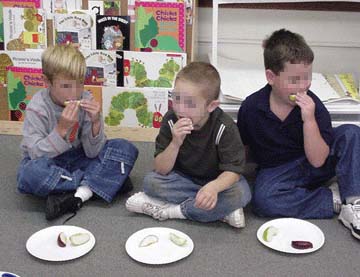
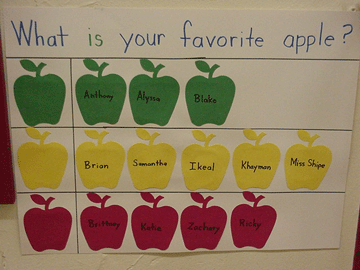
Provide samples of red, yellow, and green apples.
Have students taste each variety and choose their favorite.
Create a class graph to show the results. Count and compare the votes for each type of apple.
Apple Pattern Headbands
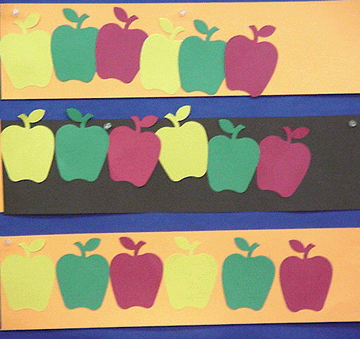
Materials:
- Paper apple cutouts
- Construction paper strips (4 × 18 inches)
- Glue
Instructions:
- Give each student a strip of construction paper.
- Provide paper apples in different colors.
- Have students create AB or ABC patterns by gluing apples onto their strips.
- Connect the ends to make apple pattern headbands.
Apple Quilt
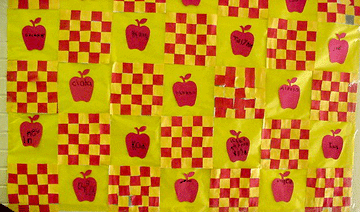
Create a classroom apple quilt using repeating patterns.
Have students glue apple cutouts onto square backgrounds, alternating colors in an AB pattern.
Combine the squares to make a large classroom quilt display.
Apple Balance Scale
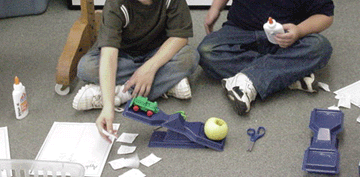
Materials:
- Balance scale
- Apples
- Classroom objects such as toy cars, glue bottles, scissors, or blocks
Instructions:
- Place an apple on one side of a balance scale.
- Place classroom objects on the other side.
- Determine how many of each object are needed to balance the apple.
- Compare the weights of different objects.
Questions to Explore:
- Which is heavier, an apple or a toy car?
- Which is lighter, an apple or a wooden block?
- How many blocks does it take to balance an apple?
Source: Science Through the Alphabet by Sue Kerr
Apple Counting and Story Problems
Use paper apples with an apple basket or tree workmat for hands-on math practice.
Skills to Practice:
- Patterning
- Counting
- Estimating
- Addition and subtraction story problems
Estimating Apple Seeds
Have students estimate how many seeds are inside an apple.
Cut open one or two apples and count the seeds.
Compare the results using the vocabulary more, less, and the same.
Apple Sorting
Provide several different types of apples.
Have students examine their similarities and differences.
Sort the apples by characteristics such as color, size, or shape.
Favorite Apple Product Graph
Ask students to choose their favorite apple product.
Choices:
- Fresh apples
- Applesauce
- Apple pie
- Apple cider
Graph the results and compare the number of votes for each category.
Apple Subtraction
Use the Five Red Apples counting rhyme with paper apples and a tree workmat.
Begin with five apples on the tree. Remove one apple with each verse.
Have students count how many apples remain.
Grandpa’s Farm Counting
Use the Grandpa’s Farm rhyme to practice counting.
Students count aloud as the imaginary apples fall from the tree onto the billy goat’s head.
Apple Fractions
Book: Apple Fractions by Jerry Pallotta
Read Apple Fractions to introduce the concept of fractions.
Cut real apples into pieces to demonstrate halves, quarters, and other fractional parts.
Measuring Apple Circumference
Materials:
- Apples
- Yarn
- Chart paper
- Tape
Instructions:
- Have students estimate how much yarn they will need to wrap around an apple.
- Students cut pieces of yarn based on their estimates.
- Wrap the yarn around the apples to check the lengths.
- Tape the yarn pieces onto a chart labeled:
- Too Long
- Too Short
- Just Right
Discuss the results and compare the lengths.
Science Activities
Comparing Apples
Ask students to bring apples from home.
Observe and discuss how the apples are alike and different.
Similarities:
- Apples grow on trees.
- They contain seeds.
- They can be eaten.
- Their skin is relatively smooth.
- Their seed chambers can form a star pattern when cut horizontally.
Differences:
- Apples vary in size and shape.
- Apples can be different colors.
- They have different flavors.
- Their textures may be different.
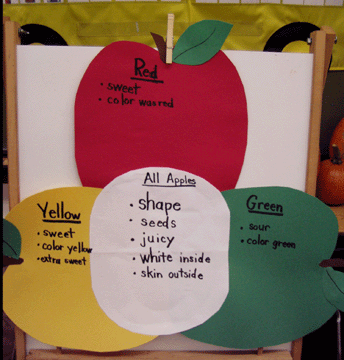
Apple Comparison Chart
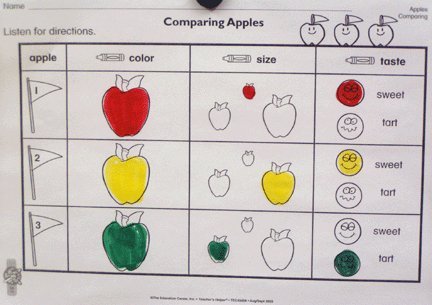
Use paper apple shapes to compare red, yellow, and green apples.
Create a chart similar to a Venn diagram showing how the apples are alike and different.
Apple Trees Through the Seasons
Book: The Seasons of Arnold’s Apple Tree by Gail Gibbons
Keep a record of how an apple tree changes throughout the year.
Use photographs or drawings to document the tree during each season.
Read The Seasons of Arnold’s Apple Tree to reinforce the seasonal changes.
Will an Apple Float or Sink?
Materials:
- Apples
- Container of water
- Other fruits or vegetables
Instructions:
- Ask students to predict whether an apple will float or sink.
- Place the apple in water to test their predictions.
- Discuss the results.
- Repeat the experiment using other fruits or vegetables.
Apple Observation Activity
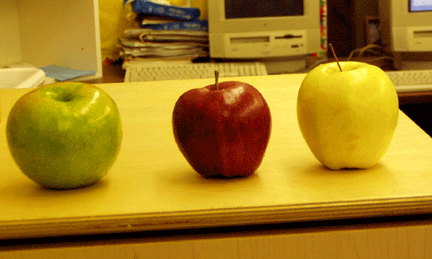
Provide red, yellow, and green apples for students to examine.
Have students observe and compare their colors, sizes, and tastes.
Record their observations on a worksheet or classroom chart.
From Seed to Apple Sequencing
Explore the life cycle of an apple tree by sequencing the stages from seed to apple.
Students can make a flap book illustrating the stages of apple growth.
The original “From Seed to Apple” flap book website is no longer available. An archived version was referenced in the original activity.
Apple Oxidation Experiment
Materials:
- Apple
- Lemon juice
- Knife (adult use)
- Science journals
Instructions:
- Cut an apple in half.
- Expose both halves to the air.
- Pour lemon juice onto one half.
- Observe the apples over time.
- Compare how the two halves change color.
Discussion Questions:
- Which apple half turns brown?
- Why do apples turn brown?
- What effect does lemon juice have on the apple?
Have students draw their observations in their science journals.
Apple Learning Centers
Apple Balance Scale
Use a balance scale to compare an apple’s weight with other classroom objects.
See Apple Balance Scale in the Math section.
Apple Patterns
Create repeating patterns using paper apples of different colors.
See Apple Pattern Headbands in the Math section.
Apple Puzzle
Create a simple puzzle by cutting apart a large paper apple.
Have students put the pieces back together.
Apple Necklace
Materials:
- Paper apple cutouts
- Hole punch
- Yarn
Have students cut out apple shapes, punch a hole at the top, and string them onto yarn to create necklaces.
Color Word Matching
Have students match colored apple cutouts to the corresponding color words.
Uppercase and Lowercase Letter Matching
Write uppercase letters on paper apples and lowercase letters on paper worms.
Have students match each lowercase worm to its corresponding uppercase apple.
Counting Apples into Baskets
Label paper baskets with numbers.
Students count out the correct number of paper apples and place them into the matching baskets.
Apple Alphabet Art
Write the letters Aa on a large paper apple.
Have students glue pieces of alphabet cereal onto the letters for extra letter recognition practice.
Social Studies Activities
From Orchard to Supermarket
Discuss how apples travel from orchards to supermarkets.
Talk about the people involved in growing, harvesting, transporting, and selling apples.
Apple Orchard Field Trip
Take a field trip to a local apple orchard or supermarket.
Observe different varieties of apples and discuss how they are grown or sold.
Johnny Appleseed
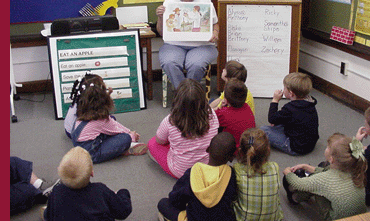
Read books about Johnny Appleseed and discuss the stories and legends associated with him.
Introduce his real name, John Chapman.
Use map skills to trace his travels and discuss where he planted apple trees.
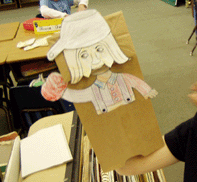
Johnny Appleseed Puppet
Create a Johnny Appleseed puppet as a follow-up activity.
Original puppet pattern source:
http://home.att.net/~elteach/appleseed.html
Health Activities
Apples and Healthy Eating
Discuss the importance of eating fruit as part of a healthy diet.
Explore where apples belong among the food groups and talk about other fruits students enjoy.
Have students name and identify a variety of fruits.
Apple Art Activities
Johnny Appleseed Hats
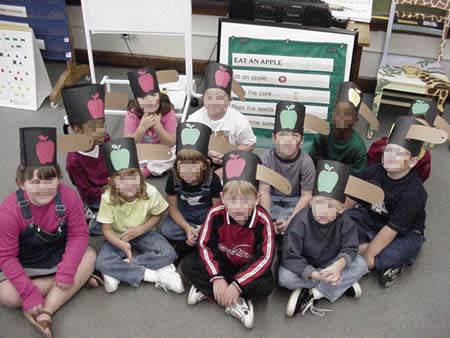
Create pretend cooking-pot hats like the one Johnny Appleseed is often pictured wearing.
Materials:
- Black construction paper
- Brown construction paper
- Paper apple cutouts
- Glue
- Scissors
Instructions:
- Cut 5-inch-wide strips of black construction paper to fit around students’ heads.
- Form each strip into a cylinder and secure the ends.
- Glue a paper apple onto the front of the hat.
- Cut a 3 × 9-inch strip of brown paper for the handle, rounding one end.
- Fold the straight end back and glue it onto the black cylinder.
- Use an apple-shaped hole punch to decorate the curved end of the handle with a tiny apple.
Stuffed Paper Apples
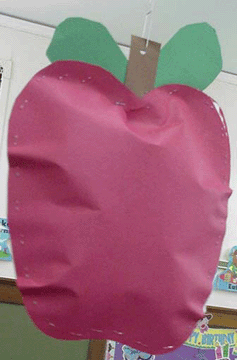
Materials:
- Large paper apple cutouts
- Fingerpaint (optional)
- Newspaper or fiberfill
- Stapler
- Paper stems and leaves
Instructions:
- Cut out two large apple shapes for each student.
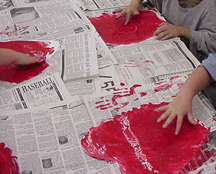
- Have students fingerpaint the apples, if desired.
- Allow the paint to dry completely.
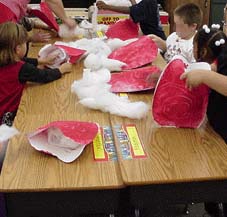
- Place the two apple shapes together and staple around the bottom edges, leaving an opening.
- Stuff the apples with crumpled newspaper or fiberfill.
- Staple the remaining opening closed.
- Add a paper stem and leaves.
These apples can also be made without fingerpainting.
Large Apple Cores
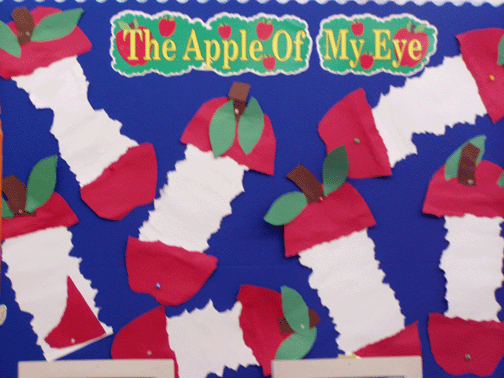
Materials:
- White construction paper
- Red construction paper
- Green and brown construction paper
- Glue
Instructions:
- Tear the edges of a white paper rectangle to create the apple core.
- Cut out the top and bottom portions of an apple from red construction paper.
- Tear the edges of the red pieces to resemble bite marks.
- Glue the red pieces onto the top and bottom of the white core.
- Add a stem and leaf.
Thumbprint Apple Art and Poem
Materials:
- Paper
- Brown and green crayons or markers
- Red fingerpaint or washable ink
- Poem
Instructions:
- Have students draw or create an apple tree.
- Let students use their thumbprints to make apples on the tree.
- Attach the following poem to the finished artwork.
Apple Tree Poem
These are special apples
Hanging on this tree.
I made them with my fingerprints.
They are a part of me!
Handprint Apple Tree
[Insert image: Handprint apple craft]
Materials:
- Paper apple cutouts
- Crayons
- Tissue paper squares
- Glue mixed with water
- Green construction paper
- Paintbrushes
Instructions:
- Have students color a paper apple.
- Glue tissue paper squares onto the apple.
- Brush a glue-and-water mixture over the artwork.
- Trace each student’s hand onto green construction paper.
- Cut out the handprint and attach it to the apple to create the stem and leaf.
- Add the following poem.
Handprint Apple Poem
This little apple that you see here
Was made just for you my kindergarten year.
You’ll never find another like it in all this great land
Because for the stem I used my own little hand.
Apple Recipes and Snacks
Homemade Applesauce
Ingredients:
- 4 apples
- 1 cup water
- ½ cup brown sugar
- ¼ teaspoon cinnamon
- ⅛ teaspoon nutmeg
Instructions:
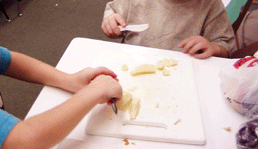
- Peel and quarter the apples.
- Place the apples and water in a saucepan and heat to boiling.
- Reduce the heat and simmer uncovered for approximately 5–10 minutes, or until the apples are tender.
- Mash or break the apples into smaller pieces.
- Stir in the brown sugar, cinnamon, and nutmeg.
- Return the mixture to a boil and cook, stirring, for one minute.
- Allow the applesauce to cool before serving.
Apple Smiles
Ingredients:
- Apple slices
- Peanut butter
- Mini marshmallows
Instructions:
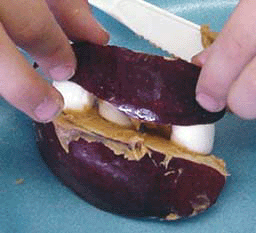
- Spread peanut butter between two apple slices.
- Place mini marshmallows between the slices to represent teeth.
- Press the apple slices together to create a smiling mouth.
Check for peanut allergies. For young children, use age-appropriate alternatives to mini marshmallows, which can be a choking hazard.
Apple Pizza
Ingredients:
- 1 package refrigerated biscuits (10 biscuits)
- Margarine
- Thinly sliced apples
- Salt
- Sugar
- Cinnamon
Instructions:
- Separate the biscuits and cut each one in half.
- Give each student half a biscuit on a piece of wax paper.
- Spread approximately 1 teaspoon of margarine onto each biscuit half.
- Add 2–3 thin slices of apple.
- Sprinkle with a small dash of salt.
- Add sugar and cinnamon.
- Transfer the biscuits to a greased cookie sheet.
- Bake at 400°F for approximately 7–9 minutes, or until the biscuits are fully cooked.
- Allow to cool before serving.
Apple Cupcakes
Source: Family Fun Magazine
Ingredients:
- 1 cupcake
- Red frosting
- 1 mini pretzel stick
- Melted chocolate
- 1 green gumdrop
- 1 gummy worm
Instructions:
- Unwrap the cupcake and cover it with red frosting.
- Dip the pretzel stick into melted chocolate and allow the chocolate to harden.
- Insert the chocolate-covered pretzel into the top of the cupcake to create an apple stem.
- Add a green gumdrop leaf.
- Cut a small “bite” out of the cupcake.
- Insert a gummy worm or half of a gummy worm into the opening.
Other Apple Snacks
Caramel Apples
Serve apple slices with caramel dip.
Apple Cider
Enjoy apple cider as part of an apple-themed snack.
Apple and Peanut Butter Sandwiches
- Cut two slices from the center of an apple.
- Spread peanut butter on one slice.
- Place the second apple slice on top to create a sandwich.
Check for food allergies before serving peanut butter or other classroom snacks.
Parent Involvement and Special Events
Apple Fun Day
Divide students into four groups and have them rotate through apple-themed learning centers.
Center 1: Apple Bingo
Play an apple-themed bingo game using letters, numbers, or words students are learning.
Center 2: Rotten Apple Game
Play the Rotten Apple Game to review letters, words, or numbers.
Center 3: Apple Crafts and Games
Activities include:
- Apple necklaces
- Apple face painting
- Apple puzzles
- Ordering apples by size
Students cut out paper apples and string them onto yarn to make necklaces.
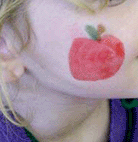
While students work, a parent helper calls children over one at a time to draw an apple on one cheek using washable markers or face paint.
Students who finish early can assemble apple puzzles or arrange apple cutouts in order from smallest to largest.
Center 4: Apple Snack
Enjoy Johnny Appleseed Sandwiches or Apple Smiles.
Apple Express
Set up different apple-themed centers in several classrooms.
Students travel from room to room to participate in the activities.
Center 1: Apple Measurement
Students estimate, weigh, and measure the circumference of apples.
Center 2: The Apple Man
Students create an Apple Man and sing Do You Know the Apple Man?
Center 3: Apple Printing
Students make placemats using apple printing techniques.
Other Apple Theme Resources
- Apples Theme — A to Z Teacher Stuff
- Biography of Johnny Appleseed
Original Print Sources:
- The Mailbox, Kindergarten, August 1995
- The Mailbox, Kindergarten, August 1989
- Once Upon a Theme, Fall Semester, The Education Center, pp. 64–73
- Letter of the Week, The Education Center, pp. 4–10
- Copycat Magazine, September/October 1997
- September Monthly Book, Kindergarten, The Education Center (TEC202)
- September Monthly Reproducibles, Kindergarten, The Education Center (TEC955)